MS in Finance
MS in Finance
MS in Finance
Build Advanced Finance Expertise
Financial decisions influence how organizations invest, fund operations and growth, evaluate opportunities, manage risk, and assess value. Those decisions draw on quantitative analysis, valuation, modeling, institutional context, and disciplined evaluation of uncertainty.
Rowan’s 30-credit Master of Science in Finance provides a specialized graduate curriculum across financial analysis and decision-making, quantitative methods, investments and portfolio management, fixed income, derivatives and risk, financial modeling, financial institutions, multinational finance, and advanced financial planning.
Across ten required graduate courses, students examine financial questions from multiple perspectives and apply analytical methods to decisions involving capital, investments, markets, risk, institutions, and financial performance.
MS in Finance at a Glance
| Credential: Master of Science in Finance Program: 30 graduate credits Curriculum: 10 required graduate courses Foundation preparation: Calculus, Accounting, Economics, Finance, and Statistics may be assigned based on prior coursework Related graduate pathway: MBA/MS Finance Related graduate credentials: Finance COGS and Finance CAGS Undergraduate pathway: BS/MS Finance ADD/4+1 |
What You’ll Study
The MS in Finance curriculum connects financial analysis, quantitative methods, investments, markets, institutions, risk, and planning across ten required graduate courses.
Financial Analysis and Decision-Making
Use financial information to evaluate performance, alternatives, investment decisions, and financial consequences.
ACC 03510 - Financial Statement Analysis (STEM*)
FIN 04500 - Financial Decision Making
Quantitative Methods and Financial Modeling
Use quantitative techniques and financial models to examine assumptions, compare alternatives, and analyze financial problems.
FIN 04511 - Quantitative Methods in Finance (STEM*)
FIN 04520 - Financial Modeling (STEM*)
Investments, Fixed Income, and Risk
Examine asset valuation, portfolio decisions, fixed-income securities, derivatives, and approaches to identifying and managing financial risk.
FIN 04600 - Investment Analysis and Portfolio Management (STEM*)
FIN 04560 - Fixed Income Securities (STEM*)
FIN 04518 - Derivative Securities and Financial Risk Management (STEM*)
Financial Institutions and Global Finance
Examine how financial institutions, markets, international conditions, and cross-border financial decisions influence the movement, pricing, and allocation of capital.
FIN 04540 - Financial Institutions Management
FIN 04530 - Multinational Financial Management
Financial Planning
Apply advanced Finance concepts to financial planning and decisions involving individual and long-term financial objectives.
FIN 04505 - Advanced Financial Planning
MS in Finance Curriculum
Required Courses - 30 Credits
1. FIN 04511 - Quantitative Methods in Finance (STEM*)
2. ACC 03510 - Financial Statement Analysis (STEM*)
3. FIN 04500 - Financial Decision Making
4. FIN 04600 - Investment Analysis and Portfolio Management (STEM*)
5. FIN 04530 - Multinational Financial Management
6. FIN 04518 - Derivative Securities and Financial Risk Management (STEM*)
7. FIN 04560 - Fixed Income Securities (STEM*)
8. FIN 04520 - Financial Modeling (STEM*)
9. FIN 04505 - Advanced Financial Planning
10. FIN 04540 - Financial Institutions Management
*STEM-designated course. The Master of Science in Finance degree itself is not STEM-designated.
2. ACC 03510 - Financial Statement Analysis (STEM*)
3. FIN 04500 - Financial Decision Making
4. FIN 04600 - Investment Analysis and Portfolio Management (STEM*)
5. FIN 04530 - Multinational Financial Management
6. FIN 04518 - Derivative Securities and Financial Risk Management (STEM*)
7. FIN 04560 - Fixed Income Securities (STEM*)
8. FIN 04520 - Financial Modeling (STEM*)
9. FIN 04505 - Advanced Financial Planning
10. FIN 04540 - Financial Institutions Management
*STEM-designated course. The Master of Science in Finance degree itself is not STEM-designated.
Graduate Business Foundation Requirements
Graduate Finance study may require prior preparation in Calculus, Accounting, Economics, Finance, and Statistics. During admission and academic planning, prior coursework is reviewed to determine which Foundation requirements, if any, remain.
Foundation coursework does not count toward the 30 graduate credits required for the MS in Finance.
Review Graduate Business Foundation Requirements
Foundation coursework does not count toward the 30 graduate credits required for the MS in Finance.
Review Graduate Business Foundation Requirements
Course Details
FIN 04511 - Quantitative Methods in Finance (STEM*)
The objective of this course is to teach students the fundamentals of quantitative finance. The topics covered in the course include asset returns and time value of money, probability and statistics in their applications to financial analysis, portfolio theory and asset pricing models, regression and econometrics for financial data analysis, structure and pricing of financial derivatives, risk quantification and management.
Foundations: Accounting I and II, Calculus, Finance, Macroeconomics, Microeconomics, Statistics.
ACC 03510 - Financial Statement Analysis (STEM*)
This course will take an expanded study of financial statement analysis from the point of view of the primary users of financial statements: equity and credit analysts. The analysis and use of financial statements will also emphasize the properties of numbers derived from these statements, business and asset valuation, and the importance and use of the notes to the financial statements. Expanded data analytic skills will be emphasized.
Foundations: Accounting I and II.
FIN 04500 - Financial Decision Making
Students in this course will learn valuation techniques including adjusted present value, equity cash flows, and real-option valuation. In addition to comparing alternative valuation techniques and the assumptions and limitations underlying each, students will explore the technical difficulties and incentive effects caused by high leverage, the relation between capital structure and capital costs, the interaction between a firm's financial structure and its business strategies, the conditions contributing to potential under or overvaluation of a firm's prospects by the market, and the managerial consequences of such misvaluation.
Foundations: Accounting I and II, Calculus, Finance, Macroeconomics, Microeconomics, Statistics.
FIN 04600 - Investment Analysis and Portfolio Management (STEM*)
In this course students will analyze and develop an ability to deal with the following topics: investment values and market price with regard to risk, return, portfolio diversification, taxes and inflation. Students will also examine the role of fixed income securities versus common stock prices, yields, returns and valuations, warrants, options and future contracts, U.S. and foreign securities markets, and the rapidly developing science of portfolio management as it applies to both the firm and the individual.
Foundations: Finance.
FIN 04530 - Multinational Financial Management
The objective of this course is to examine the managerial implications pertaining to the financial operations of the multinational firms of the investments in the international arena. The standard topics in international finance, such as exchange rate determination, foreign exchange risk (exposure), hedging techniques (using derivatives), international corporate valuation and capital budgeting, and sources of funds and the cost of capital in the international bond, stock, and money markets, are examined from a managerial point of view.
Foundations: Accounting I and II, Calculus, Finance, Macroeconomics, Microeconomics, Statistics.
FIN 04518 - Derivative Securities and Financial Risk Management (STEM*)
In this course students will learn forward, future, option and swap contracts, and hedging, arbitrage, and derivatives-pricing models. In addition, securitization and risk management concepts will be covered. Students will learn how to model and evaluate derivative instruments and their applications to corporate strategy and risk management.
Foundations: Accounting I and II, Calculus, Finance, Macroeconomics, Microeconomics, Statistics.
FIN 04560 - Fixed Income Securities (STEM*)
The objective of this course is to teach students the fundamentals of fixed income markets, covering different fixed income security types, and the mathematics of their evaluation and risk management. The topics covered in the course include fixed income security valuation, term structure of interest rates and the yield curve, fixed income risk quantification and management, securities with embedded options, credit derivatives, interest rate derivatives, and portfolio management.
Foundations: Finance.
FIN 04520 - Financial Modeling (STEM*)
The objective of this course is to teach students the fundamentals and practice of building financial models by using Microsoft Excel. Students become familiar with the built-in-functions of Excel and learn how to use them in financial model building with a hands-on-approach. The topics covered in the course include financial statement modeling, cost of capital, capital budgeting modeling, leasing, valuation analysis, portfolio modeling, capital-asset pricing models, option-pricing models, real options modeling, bonds, and term structure modeling.
Foundations: Accounting I and II, Calculus, Finance, Macroeconomics, Microeconomics, Statistics.
FIN 04505 - Advanced Financial Planning
Financial planning is the process of meeting life goals through the proper management of finances. Life goals can include buying a home, saving for your child's education or planning for retirement. Through sound financial planning individuals can make decisions that will produce their desired results. In this course, students will learn foundations of financial planning, managing basic assets, managing credit, managing insurance needs, managing investments and preparing for retirement and estate planning.
Foundations: Accounting I and II, Calculus, Finance, Macroeconomics, Microeconomics, Statistics.
FIN 04540 - Financial Institutions Management
In the course, students will learn about the many roles financial service-providers play in the economy today. Students will examine how and why the financial services marketplace as a whole is rapidly changing, becoming new and different as we move forward into the future. Students will also learn the techniques how to measure and manage various financial risks the modern financial institutions face in today's globally competitive financial environment, such as interest rate, market, credit, liquidity, off balance sheet, foreign exchange, sovereign, technology and other operational risks.
Foundations: Accounting I and II, Calculus, Finance, Macroeconomics, Microeconomics, Statistics.
Connect Your MS Finance Study With Other Rowan Finance Options
MBA/MS Finance Accelerated Pathway
Pursue the MBA and MS in Finance through approved shared coursework. Completed separately, the 36-credit MBA or STEM MBA plus the 30-credit MS in Finance total 66 credits. Eligible students may apply up to 15 approved credits toward both degrees, reducing the combined pathway to 51 credits.
The pathway can be planned with either the 36-credit MBA or 36-credit STEM MBA.
Connect MS Finance With the STEM MBA
Several required MS Finance courses carry a STEM designation, creating an opportunity to coordinate Finance coursework with Rowan’s 36-credit STEM MBA through the MBA/MS Finance accelerated pathway.
Four of the five standard MBA/MS Finance shared courses are STEM-designated. With advance planning, approved Finance coursework can support MS Finance requirements, the STEM MBA Finance Concentration, and additional STEM-designated coursework within the STEM MBA.
The MS in Finance itself is not STEM-designated.
Finance Certificate of Graduate Study
Several Finance COGS course options are also required courses in the MS Finance curriculum, allowing the 9-credit certificate to be planned entirely with direct MS Finance coursework.
Students considering the MS in Finance should select Finance COGS courses with the destination degree in mind rather than assuming every certificate option has the same MSF placement.
Finance Certificate of Advanced Graduate Study
Already hold a master’s degree? The 9-credit Finance CAGS provides an additional graduate Finance credential without requiring completion of another full master’s degree.
MBA with a Finance Concentration
Use a 9-credit Finance Concentration to build advanced Finance coursework into Rowan’s 30-credit MBA, 36-credit MBA, or 36-credit STEM MBA.
For Current Rowan Finance Undergraduates
BS/MS Finance ADD/4+1
Complete 12 approved graduate Finance credits during undergraduate study and apply them toward both the BS in Finance and MS in Finance. Completed separately, the degrees require 150 credits. The accelerated pathway reduces the combined structure to 138 credits.
Academic Planning and Student Support
Current students should use the Graduate Business Student Handbook for academic planning, registration, degree requirements, and guidance for connecting with their assigned Academic Advisor or Rowan Online Success Coach.
Prospective students should use Graduate Business Admissions for application requirements and pre-admission planning.

Meet an MS Finance Graduate
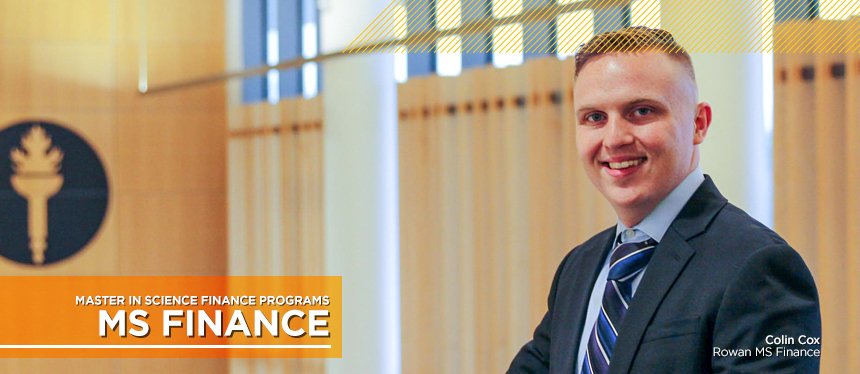
Colin Cox serves in the Army National Guard and works as a proposal analyst for Lockheed Martin. Explore his experience at Rowan and the role graduate Finance study has played across his military and civilian work.